How AI replaced me
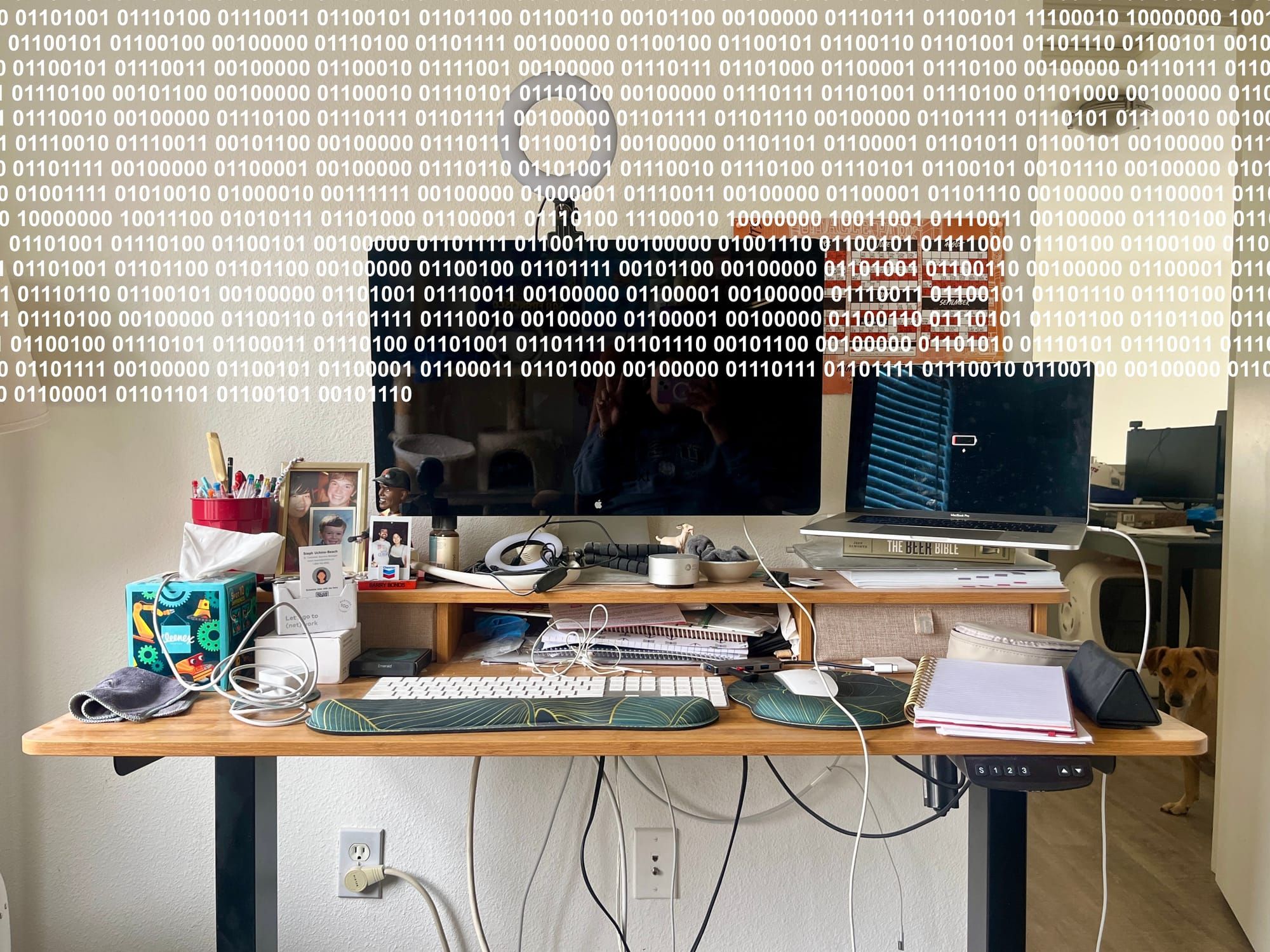
This week we’re publishing a handful of stories about the bad vibes in the tech industry. Sorry!
An hour after I was laid off, my former CEO held a seven-minute all-hands meeting to read a Claude-generated script about how leadership had “made some hard decisions but are ultimately replacing these roles with AI.” With one decision, the company let 40 people go, about 20 percent of the workforce, the culmination of a period of about six months during which roles deemed unnecessary were completely eliminated and people were quietly sent packing, including those who had won company awards earlier in the year. Some of the folks who were laid off were on company trips across the country, some were on vacation on other continents, and some were just watching in real time as their fellow employees joined 15-minute meetings and soon disappeared from Slack. If the employee couldn’t attend the HR-led meeting, they were sent an email notifying them that their role was terminated, effective the following business day.
The timing around this layoff was strange—we were days away from entering our busiest time of the year. Sales were down year over year, and the general feeling was that things weren’t going so well. Customers weren’t happy with the product, and the company wasn’t meeting its timelines. And while this company had a tendency to operate in a self-described “scrappy” manner, things felt messier than normal.
Let me back up a bit. I worked in “education tech,” or “edtech.” At the end of 2025, when the company began its push to transform into an “AI-first” outfit, I was more than a bit concerned. The news was already filled with stories about AI data centers sucking water and draining electricity, and I didn’t want any part in making these things any larger or more numerous.
It started small—directions to run documents through Claude first and use an AI notetaker for meetings, all while we were told our company would still be “human first.” But there are “levels” to AI adoption. Before long, our required AI use expanded to include scheduled AI tasks, AI-generated decks and documents, and our own AI dashboards and apps. In April, our CEO rolled out his own AI-created app meant to monitor all of the work employees completed each week. We were to report on our top outcomes, our progress toward our goals, risks or blockers (i.e., for the nontechnical folks, obstacles to adopting our software or using it more often), priorities for the following week, decisions needed from our managers. It didn’t feel great, manually inputting and handing over so much information about our daily business to an app. Micromanage-y, if not Big Brothery. Truthfully, it never led to any meaningful changes, even though I faithfully reported the problems that my customers had told me about, the stuff that was preventing them from fully implementing our product. Yet even as I could see all the ways my bosses were trying to automate my work, I didn’t think AI would replace my job entirely.
My role was based on relationships with people who are not themselves tech workers—relationships I formed through face-to-face and virtual meetings where I could answer their questions and learn about what they needed and how we could help. As the company’s post-sales partner to the customer, I was there to be a “proactive” and “strategic” guide who could ensure everything went smoothly.
It was a role with range and it varied from day to day, as I learned to understand my customers and their needs. How could AI do that? It’s been months since I lost my job and I’m still not sure if there’s an answer to that question. Based on what I’ve heard from my former colleagues, it seems like my previous company is still not sure, either.
\O/
The job that I had in tech, and even for four years before I went to work for Silicon Valley, was called a “Customer Success Manager,” or CSM for short. If you’re not familiar with the phrase, it’s all about getting a customer to feel like they got whatever a smooth-talking salesperson had sold to them (or their bosses). We’re the ones standing between very real people with very real, very human needs and a tech company that mostly just wants their money, trying to find some common ground.
In edtech, my customers were everyone from the district administrators who sat through all the salespeople’s presentations and signed on the dotted line to the teachers who actually had to use whatever service the district purchased on their behalf. Sometimes my job involved listening to district administrators when their teachers were having a hard day. Other times, it meant presenting to a room of school principals on how to use our software to better understand how their students were performing.
In tech speak, I “wore a lot of hats” in a “fast-paced environment,” meaning I offered recommendations on how to better use the curriculum and software with fidelity. It also meant that I had hard conversations to lower their expectations after salespeople sold them something we couldn’t deliver.
Officially, I was meant to be a strategic partner, splitting my loyalty between my customer and my company. But the unspoken expectation was that I would always be more loyal to the company, and when your whole goal is to have a relationship with real customers, I found it hard to be loyal to an entity that made such questionable choices.
After everyone else kicked the proverbial can down the road to close a sale, I was the person standing at the dead-end of that road. I had to clean up unrealistic promises, encourage product “stickiness” (a measure of how often users return to the product), and ensure a quick and easy renewal.
Customer Success has always been about humanity in an environment dominated by code. Nuance and empathy are at the heart of what we do. While AI can look at things like usage data and spit out recommendations, it can’t build rapport with decisionmakers, and it can’t understand the small distinctions that are unique to each school district.
It was an important role, since the product I used to deal with was complex and overwhelming for teachers who already had limited time. One very simple thing that the software did was provide slide decks for teachers to use during lessons. The trouble was that the people using them could have wildly different needs.
Consider this scenario: District A is no longer using the slides since their teachers know the lessons and feel confident they could run lessons without them. For any teacher, parent, or student—and for me and my Customer Success team—this is a good sign, as it means the teachers have bought into the curriculum.
District B, on the other hand, just doesn’t care about the curriculum, so they aren’t using the slides, which is not a good thing. District C is “using” the slides, meaning teachers are displaying them in their classrooms, but they aren’t following the curriculum. The teachers are running on autopilot, likely using an outdated curriculum, with disengaged students. That’s also not a good thing. Having spoken to administrators and teachers at all three districts at length, I know their specific situations and would have made different recommendations for each.
But what do you think AI would have inferred? It’s not: These districts are different and have different needs. Nor is it: Maybe the kids at District A really are learning and they’re ready to go further with the curriculum. It’s: District C is doing great, and District A and B need to use the slides more.
I know that’s what it would say because that’s what the data would tell it. In fact, that’s all the data could tell it, and without speaking to teachers and district personnel and taking them seriously as people, with wants and needs and problems other than problems that our product can solve, it couldn’t know anything else because it’s making decisions in a vacuum.
\O/
Getting culled from the tech world hasn’t been all bad. One thing it’s led me to do is to think about who I am outside my “tech bro” identity. (I actually love that there’s no female version of this.)
Before I went to work for Silicon Valley, I was a lot of things. A few jobs before this last one, I was an elementary school teacher in Chicago, helping kids learn to read, creating units, planning lessons, and buying supplies with my own money on the weekends, like countless other teachers around the country. I grew up on the Peninsula, and I made the move into Customer Success to get a job that would let me move home. Tech was never my dream; it was a means to an end. My dad studied computer science and still works in tech to this day and enjoys it, so it seemed like a satisfying and fruitful career was plausible. I figured that once I broke in, all my problems would be solved: I could get a house, have a kid, and fulfill every middle-class dream that had always felt slightly out of reach for a millennial like myself.
And yet, job after job, I consistently left feeling unsatisfied. Unsatisfied by how I wasn’t growing and wasn’t developing my skills. Unsatisfied with poor managers who were just in the right place at the right time to be promoted but so often lacked the skills to provide the same success for their employees. Unsatisfied with how the products I worked on could do wrong by the communities we sold them to, even though every company said they were “mission-driven” and “put our customers first.”
When I moved into edtech, I thought I had made it. Having been a teacher already, I knew how hard the job could be, and how a tech company could maybe help make it easier. It also felt good that I was able to use my master’s degree in education again, or at least fake like I was using it again. I loved working with my customers (some of whom included teachers and administrators at the Oakland unified, San Francisco unified, and Dublin unified school districts). I loved hearing about their chaotic worlds and trying to figure out how to bring some order to them.

But over and over, I saw that the customers I worked with wanted to do the most basic things, like print their students’ work, or add their students’ test scores in their district’s data warehouse so they could analyze and track their progress across grade levels. These were simple, straightforward requests, and I understood why they were important, but my company didn’t. When I tried to take customers’ requests to our Product team, our CEO would sometimes tell me outright that what I was asking for wasn’t the “right direction” for our company. He’d periodically blast me on Slack when requests like these would come up, making sure to tag my manager, as if the whole company didn’t already see his public rantings about teachers’ unwillingness to use what we had to offer them.
It was belittling and unhelpful. Instead of taking any of the comments from the people we were supposed to be helping seriously, the higher-ups kept pushing new AI features on them that they didn’t need or want and unloading their frustrations on us when teachers didn’t use them.
For all the talk about “helping teachers” and “making their lives easier,” time after time, my company showed these were just empty promises. Leadership cared about ramming AI down teachers’ throats, signing more contracts, and bringing in more cash.
One thing to understand here is that my company didn’t write the curriculum; it packaged online materials that are typically free for educators, stuck it in some software, added slide presentations, and gave it some extra bells and whistles, including AI features. Although the AI features were buggy, I’ll go out on a limb and say there was some promise there. One feature for a math program could generate practice problems for students. Offering more problems went against the curriculum’s recommendations against the outdated “drill & kill” teaching method (a standard term for giving students too much practice), but I agreed with teachers that some students need more practice than what the curriculum offers alone. By giving teachers a practice problem generator, they could stick with material that was appropriate to their students’ grade level and aligned with the lesson of the day.
But even if I could see how some of these AI features could work for some teachers in theory, talking about them seemed utterly pointless when the teachers couldn’t do the most basic things they were asking us to help them with. It’s like we were talking up a car’s bluetooth audio system when the person behind the wheel couldn’t even figure out how to move their seat back far enough to drive.
\O/
For all the talk about “helping teachers” and “making their lives easier,” time after time, my company showed these were just empty promises. Leadership cared about ramming AI down teachers’ throats, signing more contracts, and bringing in more cash. Maybe I shouldn’t have been surprised, but it was no different from every other business in Silicon Valley in that way. Maybe if I had been more skeptical from the jump, I wouldn’t have been shocked when the company that diminished the humanity in teaching started to think the same way about me and my fellow employees. But I was.
When the company started pushing AI on us, I’m not sure what I thought was going to happen, but I did not think being replaced by a water guzzling, energy-inefficient robot would be one of them. The tech industry used to have so much money that job security was an unspoken perk. But now that it’s richer than ever, it’s also become less secure, as vets with decades-long careers are laid off and then struggle to find jobs. “Overqualified” candidates and recent grads buried in student loans find they can’t get work after studying computer science for four years because entry- level roles are now getting replaced by Claude Code.
As a CSM, I refused to sell my customers on features or products that I didn’t think would be beneficial to them. I avoided roles that had a sales quota, since I felt pushing unnecessary sales violated the trust and partnership that we developed. And yet, there I was, being forced to guzzle down AI and pushing my customers to do the same.
We’re watching an already isolating industry become even more dehumanized in real time. Programmers are getting laid off in favor of AI agents. Companies are replacing budgets earmarked for salaries and repurposing them for the purchase of AI tokens (the calculated cost of running a prompt) because “AI is always the answer!” My former company used to pride itself on saying that our support chat was a human being, until we quietly replaced that person with an AI chat bot. Just as manufacturing went through waves of change from which it never really recovered, as robots replaced line workers and jobs went to countries with lower wages and weaker labor laws, AI and outsourcing are coming for tech workers.
But while some people get replaced, the remaining workers are getting pushed to their breaking point and being subjected to ever more intrusive forms of surveillance.
Three weeks into my employment, one of my teammates was cut loose for not taking “real” notes during meetings, meaning he copied them from the AI summary. Now the whole company uses Granola.ai. Beyond the fact that doing something that got a colleague fired is now company policy, this is a thing that transcribes your conversation with people outside the company without telling the other parties. More recently, I even saw a colleague fired for speaking out against unnecessary AI usage.
In the tech industry, it’s not good enough to just use AI. You have to believe in it, too.

Tech, and now AI, was supposed to make our lives better, make them easier. At least that’s what the industry pushing it told us. But instead of shortening the workday or work week because AI can handle menial tasks, the industry is “trimming the fat” (code for laying people off) so as to have fewer employees take on what should be a multiperson effort. Instead of connecting us to each other, it’s giving us AI agents to communicate on our behalf. Instead of funding things like universal health care or good wages for teachers, the tech world is dodging taxes and giving us healthtech and edtech companies that reimagine all our needs as problems that only they can solve with lines of code that they can profit from.
We’re automating the humanity out of our jobs and leaving the annoying parts. We’re using technological band aids instead of meeting our issues at the source. Tech CEOs love to make sure their employees are grinding away generating AI slop. They also love to watch their employees suffer. Let’s bring everyone back into the office. Who cares if we don’t have enough desk space? Who cares if they have to commute hours at a time? Who cares if they were hired as remote employees (and paid less for it?) We have lunch and happy hours! Why aren’t they more grateful?
Remote roles are actively disappearing and being replaced with “hybrid” work. What used to be a remote-first policy that later became a two-day office policy is now becoming three or four days in the office. We already proved that we are efficient and able to work from home, but CEOs who aren’t doing a lot on their own need us to be around so they can feel like they’re at least succeeding at ruling over their employees. The way they get there is through one dumb policy after another that takes the humanity out of even employee relations.
One trick: setting a random mileage radius and forcing people in that radius to come into the office and sit on a zoom call. Doesn’t that sound like collaboration in the making?
I am lucky that I have savings and a partner who is still employed. To be honest, losing my job has led to more relief than anything else. Relief that I’m not forced to use AI, to not have to compete with brown-nosing, push-you-down-along-the-way employees, to not have to keep lying to my customers that we’re working on fixes that are never coming because the solution has nothing to do with AI.
When looking for a job, my goal was always to find somewhere I could do good. And I didn’t mean: do my job well. I meant: do good in the world. I thought that’s what I was doing. The shift to AI snuffed out that illusion.
\O/
A few weeks after being laid off, I keep asking myself, if a human-centered job like mine can be done by AI, what does this say about our society? I like talking to people. I like forming relationships. It’s why I moved into Customer Success to begin with. Now I think I’m ready to move on. The big paycheck that I used to get isn’t worth siding with people who are out to strip humanity out of society.
When I look for reasons to be optimistic, I look back to the teachers. LAUSD, the second largest district in the US and the one that just about every school district in California looks to for guidance, has already set strict screen time limitations and other districts are following suit. California is working to pass legislation protecting students’ data from being able to train AI models. One reason the resistance is happening in schools is that school workers are unionized. They hold power to push back on technology and other classroom “requirements”.
It’s an old lesson, but one that some people are starting to learn for the first time. In another encouraging development, tech workers are starting to unionize.
We should be fighting for more employee rights and protections–in-person, face to face, together. With companies like Google, Flock, and Palantir aiding genocide in Gaza and building a private police state on our streets, the industry is counting on us not to think for ourselves and take any questions we might have to Claude instead of to each other. Under the circumstances, thinking at all and maintaining relationships is radical in itself.
As for me, what’s next? I’m not sure. After working at four different startups over the last six years, I am tired. While I got some severance, it was minimal and my insurance premiums are now almost $900 per month. The lure of tech is still there, but I still want to do good in the world. I want to make a difference. And right now, honestly, I think I want to be a beertender.
Stephanie is a Bay Area native and former tech worker living in Oakland with her husband and zoo (two dogs and two cats). She’s currently exploring funemployment within crafting and beer.